Turning an electronic product concept into a market-ready device requires more than a successful prototype. We need to validate the design, identify engineering risks, prepare the product for repeatable manufacturing, and then establish processes that can support commercial volumes. Understanding the difference between rapid prototyping and mass production helps businesses make better decisions about cost, timing, quality, and how to go from prototype to production.

What Is Rapid Prototyping?
Rapid prototyping focuses on quickly producing physical samples so we can verify whether a product performs as intended. Instead of investing in production tooling right away, businesses can leverage technologies including 3D printing, CNC machining, and silicone molding to fabricate parts for design and functional assessment. These methods are widely adopted because they enable faster iteration before making substantial manufacturing commitments.
For electronics projects, electronic prototyping can also validate PCB layouts, component integration, enclosure fit, and core functionality. A physical prototype gives engineering teams an opportunity to identify problems that may not be obvious in CAD models or simulations.
Why Electronic Prototyping Matters
A prototype is not simply an early version of the final product. Its primary purpose is to generate evidence for engineering decisions. We can test functionality, examine mechanical integration, assess user interaction, and discover design weaknesses before committing substantial resources to production.
At Minewing, our rapid prototyping process includes quick-turn samples using 3D printing, CNC machining, and silicone molding. We also support POC and functional testing against real-world scenarios. This approach helps our customers refine their products before expensive tooling and volume manufacturing begin.
How to Go From Prototype to Production
The transition from prototype to production requires a change in priorities. A prototype may be optimized primarily for speed, flexibility, or proof of concept. A production design must additionally consider repeatability, yield, assembly efficiency, component availability, quality control, and cost.
We therefore recommend reviewing the design after functional validation rather than treating the prototype as automatically production-ready. Design for Manufacturing (DFM) is particularly important because it considers actual manufacturing capabilities and constraints when preparing a product for production.
Trial Production Bridges the Gap
Moving directly from one prototype to thousands of finished units can create unnecessary risk. A trial-production stage provides an opportunity to verify that the manufacturing process can consistently reproduce the validated design.
At Minewing, we use small-batch New Product Introduction (NPI) stages, including Engineering Validation Testing (EVT), DVT, and PVT, to identify and eliminate potential production risks. Our engineers can optimize manufacturing processes, improve production yield, reduce assembly costs, and validate component supply before full-scale manufacturing.
What Changes During Mass Production?
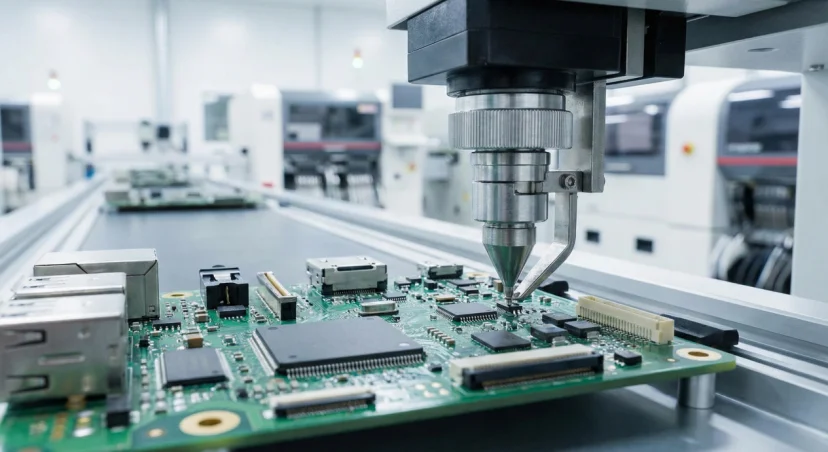
Mass production has a fundamentally different objective from prototyping. Instead of maximizing iteration speed, the focus shifts toward consistency, efficiency, scalability, and predictable delivery. Production equipment, assembly processes, inspection procedures, sourcing systems, and packaging all need to work together repeatedly.
For businesses comparing manufacturing partners, production capacity alone is not enough. We should also examine whether the manufacturer can maintain quality as output increases. Stable component sourcing and controlled manufacturing processes become increasingly important as order volumes grow.
From Flexible Samples to Repeatable Manufacturing
Rapid prototyping allows us to make changes relatively quickly. Mass production requires those changes to be controlled carefully because even a small design or process modification can affect thousands of units.
This is why we emphasize engineering optimization before scaling. At Minewing, we integrate electronics and enclosure design optimization with manufacturing considerations. Our services cover PCB design and assembly, enclosure production, testing, and packaging, creating a connected workflow from development through production.
Cost, Speed, and Quality Have Different Priorities
The economics of the two stages are also different. Rapid prototyping generally prioritizes development speed and learning. Producing a small number of samples through flexible manufacturing methods can make sense when requirements are still evolving.
Mass production, by contrast, is designed to reduce the cost per unit through repeatable processes and efficient volume assembly. We provide flexible OEM contract manufacturing and volume assembly capabilities, while also supporting packaging and global logistics. This allows production arrangements to develop alongside customers’ commercial requirements.
Choosing a Partner for the Full Product Lifecycle
For B2B buyers, the strongest manufacturing relationship does not end when a prototype passes testing. We need a partner that understands the engineering decisions behind the product and can carry those decisions into scalable production.
At Minewing, we support projects from concept and electronic prototyping through trial production and mass manufacturing. Our integrated approach combines engineering, DFM optimization, component sourcing, assembly, testing, packaging, and logistics. We also support projects ranging from individual prototypes to full-scale production without a strict MOQ requirement.
Turning a Validated Design Into a Scalable Product
Rapid prototyping and mass production serve distinct purposes, yet they should function as connected stages instead of isolated processes. Prototyping helps us identify viable solutions; trial production allows us to verify stable repeatability of the manufacturing process; mass production enables us to deliver that validated product at commercial scale.
When considering how to go from prototype to production, businesses should look beyond manufacturing capacity and evaluate engineering support, DFM capabilities, supply-chain readiness, quality control, and production scalability. At Minewing, we connect these stages through an end-to-end manufacturing model designed to help businesses move from functional prototypes to reliable market-ready hardware.