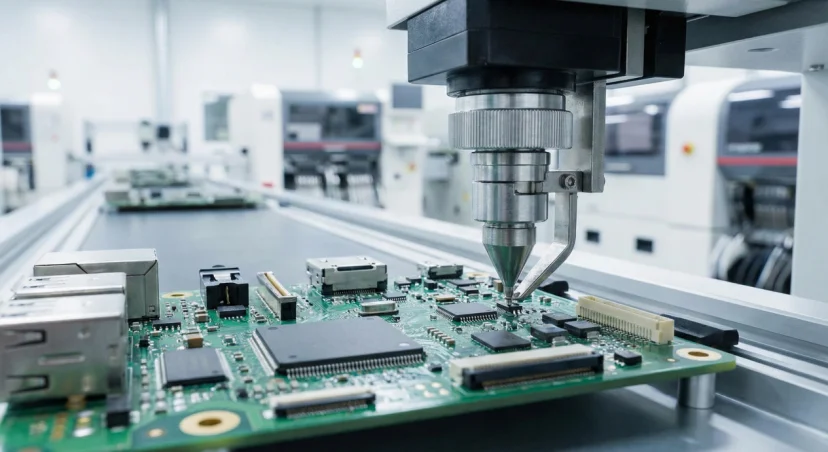
A functional prototype proves that an electronic product can work, but it does not necessarily prove that the product is ready for commercial manufacturing. The transition requires a broader assessment of design stability, component availability, manufacturing processes, testing, cost, and production capacity. For B2B product teams, understanding how to go from prototype to production helps prevent expensive redesigns and production delays while creating a more predictable path toward market launch.

Confirm the Design Is Ready for Manufacturing
The first step is determining whether the prototype has been engineered for repeatable manufacturing rather than simply demonstrated functionality. Review the schematic, PCB layout, bill of materials, firmware, mechanical drawings, enclosure design, and assembly instructions.
This stage should identify components that are difficult to source, unnecessarily complex assembly steps, tight mechanical tolerances, thermal concerns, and other potential manufacturing obstacles. Design for manufacturability is especially important when production volumes increase because small inefficiencies can become significant costs across thousands of units.
Our engineering approach at Minewing considers manufacturing requirements during development. We support electronics hardware, software, structural processes, exterior design, and packaging, allowing potential production issues to be addressed before they become expensive late-stage changes.
Validate the Prototype Beyond Basic Function
A prototype should do more than switch on and demonstrate the core concept. Before production, teams should verify performance under the conditions the finished product will encounter.
Depending on the application, this can include functional testing, temperature testing, durability evaluation, power-consumption checks, connectivity validation, and other application-specific tests. The objective is to establish clear acceptance criteria rather than relying on subjective judgments such as whether a prototype “looks ready.”
This is where electronic prototyping becomes particularly valuable. A well-planned prototype provides evidence about the design while exposing issues that may not appear in simulations or early engineering reviews. At Minewing, we regard prototyping as a stage for validating ideas and designs, testing functional samples, and confirming the production process with customers.
Review the Bill of Materials and Supply Chain
A prototype may use readily available components that become difficult or expensive to procure at production volumes. Therefore, the bill of materials should be reviewed before approving mass production.
Check component availability, approved manufacturers, lead times, minimum order quantities, lifecycle status, and potential alternatives. Critical components should have defined substitution procedures so that changes do not occur without engineering approval.
We also recommend examining the supplier’s sourcing and quality-control practices. At Minewing, our electronics manufacturing service relies on a professional component supply chain and sources BOM components through original manufacturers’ first agents for our PCBA projects.
Establish a Production-Ready Testing Strategy
Testing should evolve with the product. A prototype may be tested manually by engineers, while production requires a repeatable process that operators and automated equipment can execute consistently.
Define functional test requirements, inspection points, programming procedures, and acceptance criteria before the production run. Testing should cover the characteristics that matter to the finished product rather than simply checking whether the device powers on.
At Minewing, our factory capabilities include AOI, X-ray inspection, programming, aging testing, finished-product assembly, and functional testing. Such capabilities support a transition from engineering validation toward controlled manufacturing processes.
Use Trial Production Before Mass Production
Moving directly from a successful prototype to a large production order can introduce unnecessary risk. A pilot or trial-production run provides an intermediate stage where the manufacturer can validate processes using production-intended materials, equipment, tooling, and assembly methods.
The trial run can reveal problems with component placement, soldering, assembly sequence, enclosure fit, packaging, testing, or production documentation. Teams can then correct these issues before committing to larger volumes.
At Minewing, we explicitly include trial production between prototyping and mass production and treat it as a necessary step for confirming samples and validating the production process.
Calculate the Real Production Cost
Prototype economics and production economics are different. Before scaling, calculate the complete unit cost rather than looking only at the PCB or component price.
Consider materials, PCBA assembly, tooling, enclosure production, labor, testing, packaging, shipping, engineering changes, and expected production yield. Tooling costs and non-recurring engineering expenses should also be separated from recurring unit costs.
A production-ready design should balance performance with manufacturability. Sometimes a small design change can reduce assembly complexity or material consumption without affecting the product’s intended function.
Choose a Partner That Can Scale With You
The manufacturing partner should have capabilities that match both current requirements and future production plans. Ask whether the supplier can support prototype builds, pilot production, and larger-volume manufacturing without forcing the project through completely different suppliers.
An integrated partner can also reduce communication gaps between electronics, mechanical manufacturing, assembly, testing, and packaging. At Minewing, weprovide a one-stop manufacturing model covering the progression from idea and design through prototype, trial production, and mass production.
Build a Clear Path From Prototype to Production
Knowing how to go from prototype to production means treating production readiness as a structured engineering process rather than simply placing the first large order. Design verification, component planning, manufacturing optimization, testing, trial production, and cost analysis all contribute to a successful transition.
At Minewing, our Comprehensive Electronic Design and Manufacturing Services are structured to support this complete journey, from initial concept through production and delivery. Our goal is to help customers develop products that are not only functional prototypes but also manufacturable, testable, scalable products prepared for commercial requirements.
The strongest production strategy begins before the prototype is considered finished. By involving manufacturing expertise early, validating the design systematically, and using trial production to confirm the process, B2B teams can reduce avoidable risks and create a more reliable route from engineering concept to market-ready product.