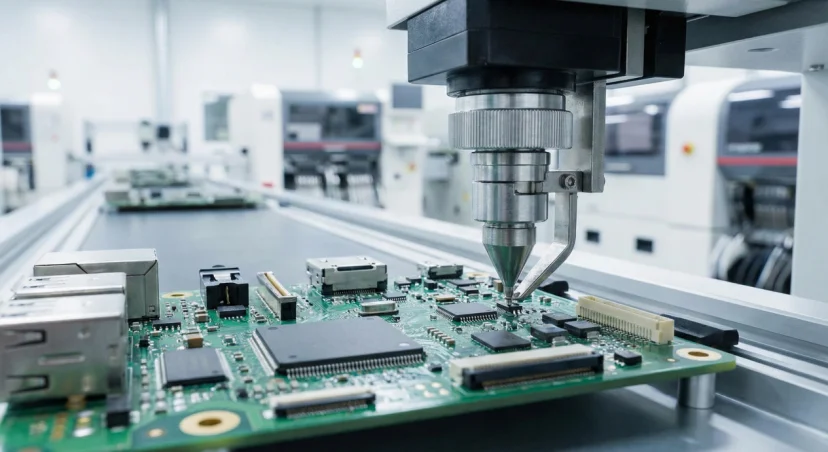
A promising electronics concept needs more than a good idea to become a commercial product. It needs engineering expertise, manufacturability planning, component sourcing, prototyping, testing, and controlled production. For companies without an extensive internal hardware team, an ODM partner can connect these stages. When evaluating a manufacturing agent ODM China partner, B2B buyers should look beyond factory capacity and assess how effectively the partner can turn an early concept into a production-ready product.
What Does ODM Mean for Electronics Development?
Original Design Manufacturing (ODM) combines product development and manufacturing under a supplier’s responsibility. Rather than providing a fully engineered design for a factory to build, the customer can bring a product concept, requirements, or market opportunity while the ODM partner contributes engineering and manufacturing expertise.
We see this model as valuable for companies that know their target market but lack adequate electronics development resources. As your partner, we can support hardware architecture, component selection, PCB design, prototyping, design optimization, and production preparation.
For B2B buyers, the key advantage is continuity. Instead of transferring a project between independent engineering and manufacturing companies, development decisions can remain connected to production requirements from the beginning.
Turning a Product Idea Into an Engineering Plan
The transition from concept to product starts with defining what the device must actually accomplish. Functional requirements, operating conditions, connectivity, power requirements, user interactions, target cost, and expected production volume should be established early.
We approach ODM electronics projects by first understanding the customer’s requirements and then translating those requirements into an engineering plan. Our engineering resources cover electronics hardware, software, structural processes, exterior design, and packaging. This multidisciplinary approach allows us to consider both electronic and mechanical requirements during development.
This early coordination can also expose technical risks before substantial tooling or production costs are committed.
Why Design for Manufacturing Matters
A circuit that works on a development board is not automatically ready for commercial production. Component placement, PCB layout, enclosure tolerances, assembly methods, thermal management, and test access can all affect manufacturing efficiency and reliability.
Design for manufacturing (DFM) therefore needs to be considered during development rather than after the design has been finalized. An experienced ODM partner can identify opportunities to simplify assembly, improve material selection, and make production processes more repeatable.
Our design service specifically emphasizes design-for-manufacturing expertise across electronics and mechanical areas. We advise customers at the early stage so resources can be organized while time and cost risks are addressed before they become more difficult to correct.
From Prototype to Production Validation
Prototyping creates an important bridge between engineering assumptions and physical product performance. A prototype allows the development team to evaluate functionality, identify design problems, and determine whether the proposed production process is practical.
We treat prototyping as a validation stage rather than simply producing a sample. Our published process describes prototype development as a way to validate ideas and designs, test functional samples, and confirm the production process with customers.
After prototype validation, trial production can provide another layer of verification. It helps confirm whether the design, materials, assembly methods, testing procedures, and production documentation can work together before larger-scale manufacturing begins.
Managing Components and Manufacturing Complexity
Electronics ODM also involves managing a substantial supply chain. The bill of materials may contain processors, memory, sensors, wireless modules, connectors, power-management components, and other specialized parts. Availability and sourcing decisions can directly influence production schedules and product cost.
We integrate component sourcing into our manufacturing service and state that BOM components for our PCBA projects are sourced through original manufacturers’ first agents. We also provide technical support during product optimization, prototyping, testing improvement, and mass production.
For customers, this integrated approach can reduce the number of independent parties involved in the development and manufacturing process.
Building Strong Business Manufacturing Partnerships
Successful B2B manufacturing partnerships require more than a supplier that can accept purchase orders. Both sides need clear communication, documented requirements, engineering-change procedures, quality expectations, schedules, and responsibilities.
Quality management is another important consideration. ISO describes ISO 9001 as a globally recognized quality management standard designed to help organizations establish, maintain, and continually improve quality-management processes.
We believe the manufacturing relationship should develop alongside the product. Our published service process connects idea, design, prototype, trial production, and mass production, creating a continuous path rather than treating each stage as an isolated transaction.
Choosing the Right China ODM Partner
The right manufacturing agent ODM China partner should be able to demonstrate more than manufacturing capacity. B2B customers should evaluate engineering capabilities, DFM experience, prototype support, component sourcing, testing, production scalability, project management, and communication.
At Minewing, our ODM Electronics service is designed for customers who have a product idea and market opportunity but need technical expertise to develop it. We handle the hardware design process and work toward transforming the concept into a production-ready product. Our broader integrated model connects design and development with prototyping, trial production, and mass production.
The real value of ODM is the connection between these stages. When engineering and manufacturing teams work toward the same production objective, decisions made during development can better support quality, cost, scalability, and market requirements. For B2B companies seeking to turn an electronics concept into a commercially viable product, that continuity can make the journey from idea to assembly considerably more manageable.