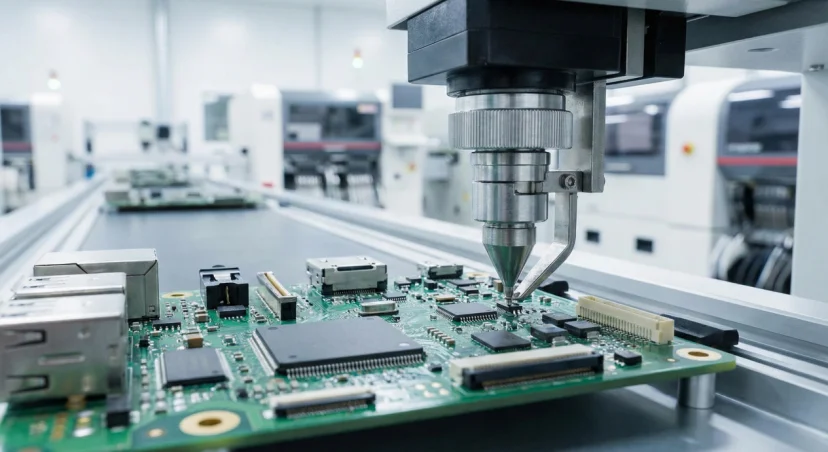
Energy efficiency is becoming a more important consideration across the electronics value chain. Rising computing workloads, increasingly compact hardware, and growing demand for connected devices are putting greater pressure on both product designers and manufacturers to control energy consumption. Recent electronics manufacturing services news also reflects this shift, with efficiency increasingly connected to semiconductor design, thermal management, power infrastructure, and production optimization. For us, the goal is to help startups and growing brands turn efficiency considerations into practical, manufacturable products.
Why Energy Efficiency Matters to Electronics Manufacturers
Energy efficiency is no longer limited to the final device’s power consumption. Manufacturing decisions can influence how much energy a product requires during operation, how effectively it manages heat, and how efficiently it can be produced.
This broader perspective matters as electronic systems become more powerful. Recent developments in AI infrastructure, for example, are increasing demand for both electricity and cooling, encouraging manufacturers to explore more efficient power and thermal technologies.
For product companies, this creates an important connection between engineering and manufacturing. A design optimized for lower energy consumption still needs to be practical to assemble, test, source, and scale. We therefore consider efficiency alongside reliability, manufacturability, cost, and production requirements.
Efficient Hardware Design Starts Before Manufacturing
One of the most effective opportunities to improve efficiency appears during the design stage. Component selection, PCB architecture, power management, and system integration can all influence a product’s energy requirements.
We at Minewing support customers with hardware design and PCB layout, helping evaluate technical requirements before a product reaches production. Our engineering services focus on areas such as functionality, signal integrity, and miniaturization, which can contribute to a more efficient overall hardware architecture.
Our early involvement can also prevent inefficient designs from turning into costly manufacturing issues. When engineers evaluate component availability, board layout, assembly requirements, and production constraints together with us, they gain more opportunities to optimize the product before tooling or mass production starts.
Power and Thermal Management Are Closely Connected
Higher performance often brings greater thermal challenges for electronic products. As components draw more power, they generate excess heat that can compromise product performance, reliability, and component lifespan. For this reason, we integrate energy efficiency and thermal management into our core design and manufacturing considerations.
Current industry developments demonstrate this relationship clearly. Data-center infrastructure manufacturers are investing in technologies such as solid-state transformers and advanced cooling systems as AI workloads increase power and heat requirements.
For smaller electronic products, the same principle applies at a different scale. During development, we can consider enclosure design, component arrangement, PCB configuration, and manufacturing requirements together. With this integrated methodology, we help customers resolve thermal and electrical design considerations early, before such issues become hard to adjust.
Manufacturing Process Optimization Can Reduce Waste
Energy efficiency is also influenced by how products are manufactured. Inefficient assembly processes, unnecessary material usage, production defects, and repeated rework can increase resource consumption while raising manufacturing costs.
Our approach connects design optimization with production preparation. During New Product Introduction (NPI), we use trial production to identify potential manufacturing risks, while Design for Manufacturing (DFM) helps improve production yield and reduce unnecessary assembly complexity.
Better yield is particularly valuable for growing businesses. When more finished units meet specifications on the first production run, manufacturers can reduce material waste and avoid the additional processing associated with defective products. This makes process efficiency both an operational and commercial consideration.
Prototyping Helps Validate Efficiency Earlier
Rapid prototyping provides another opportunity to identify potential problems before committing to larger production volumes. We provide functional prototypes using methods such as 3D printing, CNC machining, and silicone molding, allowing customers to evaluate designs before expensive tooling.
For energy-conscious products, prototypes can support functional and performance validation. Teams can examine hardware behavior, component integration, enclosure design, and other factors before moving into trial production. Detecting a design issue at this stage is generally easier than correcting it after production has scaled.
We find this especially helpful for startups, who need to balance ambitious product specifications with limited development resources. A structured prototype-to-production process gives them more opportunities to make informed decisions before committing substantial manufacturing resources.
Integrated Manufacturing Supports Long-Term Efficiency
We support startups and growing brands from prototyping to mass production, providing flexible, reliable, and cost-effective integrated solutions. Our services span concept development, engineering, rapid prototyping, trial production, PCBA and enclosure manufacturing, testing, packaging, and global delivery.
Keeping these stages connected can improve manufacturing efficiency because information does not have to be repeatedly transferred between unrelated suppliers. Engineering teams can communicate production requirements earlier, while manufacturing feedback can inform product improvements before volume production.
We also provide flexible production support, from individual prototypes and low-volume trials to mass production. This allows growing brands to scale in line with market demand instead of building their manufacturing strategy around a fixed production volume.
Turning Efficiency Trends Into Practical Manufacturing
The most useful electronic manufacturing services news is not simply about new technologies. It should help product teams understand how changing requirements affect real-world design and manufacturing decisions. Advances in power management, thermal technologies, semiconductor architectures, and production optimization are all influencing how electronic products are developed.
At Minewing, we focus on connecting these considerations across the product lifecycle. We help customers evaluate designs, build functional prototypes, optimize manufacturing processes, and transition toward scalable production. By combining engineering and manufacturing capabilities, we help startups and growing brands pursue energy-conscious products without losing sight of reliability, manufacturability, cost, or commercial scalability.