Reliable electronics require more than functional designs and competitive production costs. For companies outsourcing manufacturing, quality and compliance must be built into the entire product lifecycle, from engineering review and component sourcing to assembly, testing, and shipment. We believe a strong electronic manufacturing service should provide customers with consistent processes, traceability, and practical quality controls that reduce production risk.
Build Quality into the Product from the Start
Quality control should begin before the first production run. We work with customers during design and development to review manufacturability, identify potential process problems, and improve the product before tooling or mass production begins. This approach can reduce avoidable rework and make later production more consistent.
For startups and established brands alike, design changes can affect component availability, assembly methods, testing, and cost. A capable electronics manufacturing services partner should therefore connect engineering decisions with manufacturing requirements instead of treating design and production as separate activities.
Establish Clear Quality Standards and Acceptance Criteria
A professional manufacturing program needs objective criteria for deciding whether an assembly is acceptable. IPC standards are widely used for electronics production. IPC J-STD-001J defines requirements for materials, processes, and acceptance criteria for soldered electrical and electronic assemblies, while IPC-A-610J provides post-assembly acceptance criteria. These standards can create a common quality language between customers, engineers, inspectors, and production teams.
For B2B buyers, these criteria are particularly useful when comparing manufacturing partners. We make supplier evaluations more concrete because quality can be discussed through defined processes, measurable inspection points, documented results, and agreed acceptance standards instead of relying only on general claims about reliability.
We also recommend defining product-specific inspection requirements before production starts. The quality plan should identify critical dimensions, electrical functions, cosmetic requirements, testing methods, sampling rules, and procedures for handling nonconforming units.
Control Components and the Supply Chain
Component quality directly influences finished-product reliability. Effective electronics manufacturing services should therefore include disciplined supplier and material controls. We verify incoming materials as part of our quality approach and use controlled sourcing channels for electronic components.
Traceability is equally important. Part numbers, revisions, batch information, inspection records, and production records should be organized so that potential quality issues can be investigated efficiently. Strong supply-chain control also helps manufacturers respond more systematically when components become unavailable or product specifications change.
Use Process Control and Inspection at Key Stages
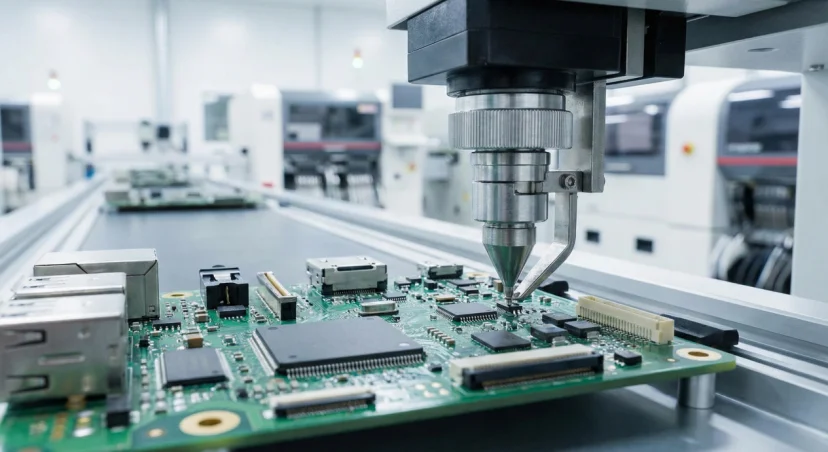
Inspection should not depend only on final testing. Quality can be strengthened by controlling important production stages and checking outputs as work progresses. For PCB assembly, this may include solder-paste printing, component placement, reflow, solder inspection, and functional verification.
We use equipment and processes that support inspection throughout PCBA production, including SPI, AOI, and X-ray inspection capabilities. Our factory information also identifies SMT and DIP production lines and functional testing. These controls help us detect manufacturing issues earlier rather than allowing defects to move through the entire production flow.
Treat Compliance as a Product Requirement
Regulatory compliance should be considered alongside electrical, mechanical, and performance requirements. Depending on the destination market and product category, customers may need to address requirements such as RoHS, electromagnetic compatibility, safety, or other applicable regulations. The exact obligations should be confirmed for the specific product and market rather than assumed.
Documentation is an important part of this process. A manufacturing partner should maintain relevant material information, test records, inspection results, and compliance documentation. We list certifications and compliance-related qualifications including CE, CB, RoHS, FCC, ETL, and ISO 9001 on our company website, providing a foundation for customer and project requirements.
Manage Prototypes, Trial Production, and Mass Production
A reliable quality system should continue through every production stage. Prototype builds are useful for validating product functions and manufacturing processes, while trial production provides another opportunity to confirm whether the process can consistently deliver the approved result.
We follow a one-stop workflow covering idea, design, prototype, trial production, and mass production. Our mass-production service includes raw material procurement, SMT, mold and shell production, assembly, testing, packaging, and shipment, with quality inspection and process control throughout the workflow.
Keep Records and Improve Continuously
Quality management becomes more effective when decisions are based on evidence. Production records, inspection data, customer feedback, defect analysis, and corrective actions can reveal recurring problems and opportunities for improvement. ISO 9001 emphasizes a process approach, performance evaluation, and continual improvement within a quality management system.
We apply this mindset to project management and manufacturing by reviewing workflows and responding to customer requirements throughout development and production. For B2B customers, this ongoing communication is especially valuable because quality is connected not only to the product itself but also to delivery schedules, cost control, scalability, and long-term supply relationships.
Building a More Reliable Manufacturing Partnership
Quality and compliance are strongest when they are integrated into engineering, sourcing, production, inspection, documentation, and continuous improvement rather than handled as a final checkpoint. We aim to provide that integrated approach through our electronic manufacturing service for startups and global brands.
Our experience spans IoT, smart home products, wearables, and other customized electronics, with support from initial concept and prototyping through mass production. By combining engineering support, supply-chain management, manufacturing, and testing in one workflow, we at Minewing help customers build products with greater consistency and clearer control over production risks.