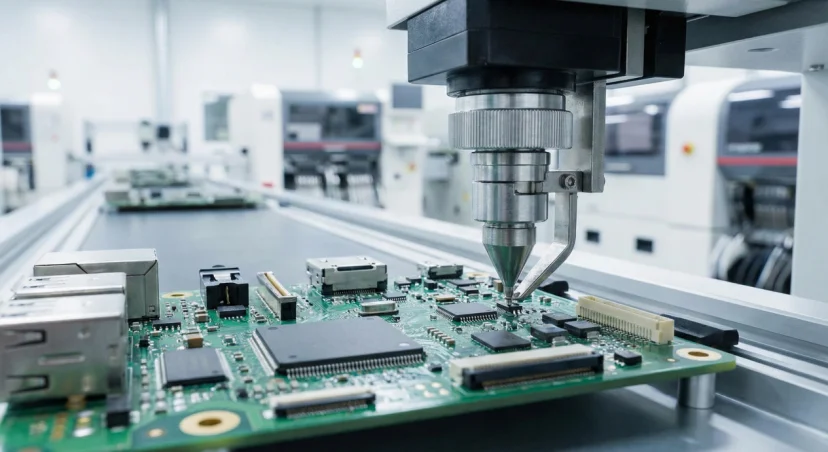
Electronics manufacturing decisions rarely exist in isolation. A change in component availability, production capacity, semiconductor demand, tariffs, or manufacturing technology can quickly affect whether a product design remains practical to build at scale. For engineering and procurement teams, following contract manufacturing electronics news therefore provides more than industry awareness. We see these developments as useful signals for reviewing Design for Manufacturing (DFM), sourcing strategies, and production risks before they become costly problems.

Why Manufacturing News Matters to DFM
DFM connects product design with the realities of production. Engineers consider component selection, PCB layout, assembly methods, materials, tolerances, testing, and production processes to make a design easier and more economical to manufacture.
We believe manufacturing news adds another layer to this evaluation. A design that works technically today may become harder to manufacture if a key component becomes constrained or if production capacity shifts toward another application.
Recent semiconductor developments demonstrate this point. Strong AI-related demand is putting pressure on memory and advanced-chip supply, while manufacturers are expanding capacity and adjusting investment plans. Such developments can encourage product teams to review component alternatives, sourcing flexibility, and production assumptions earlier in the design cycle.
Using Contract Manufacturing Electronics News to Review Components
Component availability is one of the most practical areas where news can influence DFM decisions. When contract manufacturing electronics news reports shortages, price increases, capacity constraints, or changing supplier priorities, we can use those signals to reassess the BOM.
Rather than waiting until production begins, engineering teams can identify components with limited sources or long lead times. We may then evaluate qualified alternatives, package compatibility, lifecycle status, and PCB footprint implications.
This approach does not mean changing components simply because a headline appears. Instead, we use market information to determine which parts deserve additional engineering attention. A flexible BOM and well-documented alternatives can reduce the disruption caused by unexpected supply changes.
Electronic Manufacturing Services News and Production Capacity
Manufacturing capacity can also influence DFM. When certain technologies experience rapidly increasing demand, production resources may become more difficult or expensive to secure. Current semiconductor industry developments show how AI demand is influencing fabrication investment and equipment requirements.
For product teams, this creates a useful question: Can our design be manufactured efficiently using the processes and suppliers available to us?
We consider factors such as assembly complexity, specialized processes, component availability, testing requirements, and expected production volume. A design optimized around an increasingly constrained process may create unnecessary business risk, while a design compatible with broader manufacturing capabilities can provide greater flexibility.
Turning Industry Signals Into DFM Actions
Following electronic manufacturing services news becomes valuable only when information leads to concrete engineering action. We recommend using relevant industry developments as inputs for a focused DFM review.
First, we identify whether a reported industry change affects our BOM, manufacturing process, cost assumptions, or production schedule. Next, we evaluate the technical consequences of possible changes. Finally, we validate those changes through prototypes or trial production before committing to volume manufacturing.
This process is particularly important for businesses moving from prototype to mass production. A design that performs correctly in a small batch may still require optimization for repeatable, high-yield manufacturing.
How We Apply DFM at Minewing
At Minewing, we approach DFM as part of the transition from engineering design to dependable production. Our manufacturing services cover the product lifecycle from concept and PCBA development through prototyping, trial production, assembly, testing, and mass production.
Our DFM work focuses on practical manufacturing considerations, including production efficiency, assembly costs, component sourcing, and reliability. During trial production, we use small batches to identify potential manufacturing risks before larger production commitments are made.
We also recognize that engineering decisions need clear communication. When a manufacturing issue emerges, our goal is not simply to point out the problem. We work with our partners to understand its impact and determine a practical solution that supports the product’s technical and commercial objectives.
Building a More Resilient DFM Strategy
News should not dictate product design, but it should inform risk assessment. We encourage businesses to monitor several areas consistently: component supply, semiconductor capacity, manufacturing technology, logistics conditions, production costs, and regulatory developments.
These signals can then become inputs for engineering reviews. For example, a supply constraint may justify a second-source investigation, while increasing assembly complexity may justify PCB redesign or process optimization.
Our experience tells us that the strongest DFM strategies balance engineering performance with manufacturing resilience. A product should not only function according to its specification; it should also be practical to source, assemble, test, scale, and maintain throughout its commercial lifecycle.
Making News Useful for Better Manufacturing Decisions
For B2B electronics companies, contract manufacturing and electronics manufacturing services news can provide an early warning system for potential manufacturing risks. The real value comes from connecting those external signals with internal engineering reviews.
At Minewing, we help our partners succeed through transparent communication, stable supply chains, and a problem-solving mindset. By combining manufacturing experience with DFM and supply-chain considerations, we aim to help businesses move from promising designs toward reliable, scalable production and build long-term manufacturing partnerships they can trust.