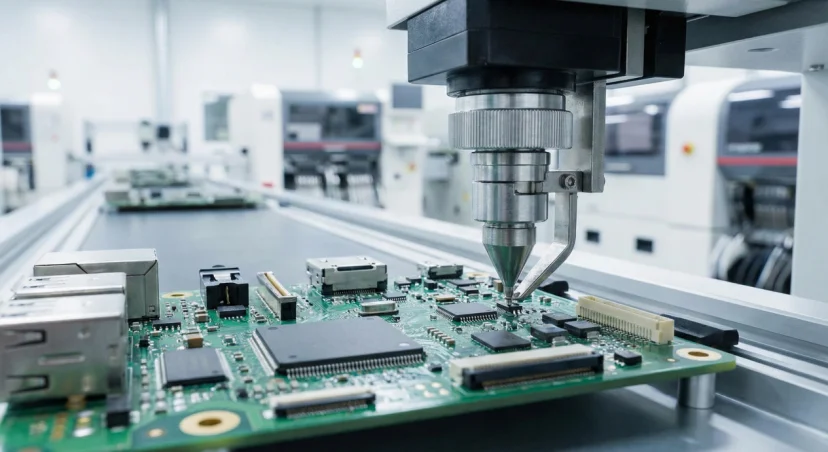
Bringing a smart electronic device to market involves much more than manufacturing a printed circuit board. A finished product may require electronic components, wiring, displays, sensors, mechanical enclosures, firmware, testing, and retail packaging. Coordinating these elements across different suppliers can increase project complexity, extend lead times, and create quality inconsistencies.
For businesses developing IoT equipment, wearable technology, and other connected products, box build assembly offers a more integrated manufacturing approach. By combining multiple production activities under one coordinated process, brands can simplify supplier management and focus on product development, market positioning, and business growth.

What Is Turnkey Box Build Assembly?
Turnkey Box Build Assembly refers to the process of producing a complete electronic product rather than supplying only an assembled PCB. Depending on the product design, this process can include circuit board assembly, component installation, cable and harness integration, enclosure assembly, software loading, functional testing, and final packaging.
The scope varies according to product requirements. A simple electronic controller may need a PCB, connectors, housing, and basic testing. A smart home device could require wireless modules, antennas, sensors, displays, power supplies, and firmware configuration.
Unlike component-level manufacturing, Turnkey Box Build Assembly coordinates these activities toward a finished, usable product. This makes it particularly relevant to businesses that need a manufacturing partner capable of managing several interconnected production stages.
Product Definition and Engineering Preparation
The process begins with understanding the product concept and translating it into an engineering plan. Before production starts, manufacturers need information about core functions, operating environments, technical specifications, target costs, and expected production volumes.
At Minewing, we begin with idea conceptualization and requirement analysis. We work with clients to assess product feasibility, component selection, cost targets, and suitable technology solutions. This early collaboration helps identify engineering challenges before they affect production schedules.
Our electronic ODM capabilities also support businesses that need assistance developing a product from an initial concept. Depending on project requirements, engineering preparation can include hardware architecture, PCB design, mechanical structures, and product appearance.
Hardware Design and PCB Assembly
The PCB serves as the electrical foundation of most smart devices. It connects processors, memory, sensors, communication modules, power management circuits, and other electronic components. Its design influences product performance, dimensions, thermal behavior, and manufacturing complexity.
A manufacturing partner should review schematics, PCB layouts, component specifications, and assembly requirements before production. Signal integrity, power distribution, electromagnetic compatibility, and component availability all deserve attention.
For smart devices, PCB assembly may also involve wireless communication modules, battery management systems, and interfaces for external sensors or displays. Electronic ODM projects benefit from coordinating these decisions with mechanical design, ensuring that the circuit board fits the enclosure and supports the intended user experience.
Enclosure, Wiring, and Mechanical Integration
A complete electronic product needs a physical structure that protects internal components and supports everyday operation. Box build work may include installing the PCB into an enclosure, connecting cables, mounting displays, attaching buttons, and integrating power supplies or cooling components.
The mechanical design must account for dimensions, material properties, assembly access, heat dissipation, and environmental conditions. Products intended for industrial environments may require stronger housings, while wearable devices prioritize compact dimensions, comfort, and lightweight construction.
Cable routing and connector placement also affect reliability. Proper strain relief, secure connections, and organized internal layouts help reduce assembly errors and improve serviceability.
Firmware Loading and Functional Configuration
Many smart devices require software configuration before they are ready for use. Depending on the product, this stage may involve loading firmware, configuring communication settings, programming device identifiers, and checking sensor or wireless functions.
For example, a connected monitoring device may need its communication module configured before it can transmit information to a cloud platform. A smart controller may require firmware that coordinates inputs, outputs, and user controls.
These activities should follow documented procedures so that production units behave consistently. Turnkey Box Build Assembly can include software loading and configuration when these requirements are incorporated into the manufacturing plan.
Testing and Quality Control
Testing confirms whether the assembled product meets its functional and quality requirements. Depending on the design, manufacturers may conduct electrical inspections, power-on checks, functional testing, communication verification, and mechanical inspections.
Testing should cover both individual subsystems and the complete device. A PCB may pass electrical inspection but still experience problems after installation in its enclosure. Similarly, wireless functions should be checked under conditions representative of the intended application.
At Minewing, we incorporate validation into the development and production process. Our rapid prototyping and trial production stages help identify potential issues before mass production. EVT, DVT, and PVT activities can provide structured opportunities to evaluate functionality, design maturity, and manufacturing readiness.
Trial Production, Mass Production, and Delivery
Before full-scale manufacturing, trial production helps verify whether the product can be assembled consistently. Design-for-manufacturing optimization, component validation, production workflow reviews, and supply chain preparation can reduce avoidable risks.
Turnkey Box Build Assembly can then extend into volume production, final inspection, retail packaging, and logistics. A capable partner should establish clear quality criteria and production procedures while maintaining flexibility as order quantities change.
Our manufacturing services cover the transition from prototypes to trial production and mass production. We support supply chain setup, volume assembly, packaging, and global shipping according to project requirements. This coordinated approach helps businesses manage the complete journey rather than organizing every production stage independently.
Choosing the Right Manufacturing Model for Smart Devices
The appropriate manufacturing arrangement depends on internal engineering resources, product complexity, and desired supplier involvement. OEM manufacturing generally follows customer-provided designs, while electronic ODM services can include more extensive product development and engineering support.
Businesses should evaluate a partner’s engineering capabilities, prototyping process, quality management, sourcing experience, production capacity, and communication practices. Clear project documentation and defined responsibilities are equally important when multiple technical disciplines are involved.
From Product Concept to Finished Smart Device
A smart device requires coordinated engineering, electronic assembly, mechanical integration, software configuration, testing, and delivery. Understanding what each stage includes helps businesses plan budgets, production schedules, and supplier responsibilities more effectively.
With our integrated development and manufacturing capabilities, we at Minewing help clients move from initial concepts toward market-ready products. Combining engineering support, electronic ODM expertise, and Turnkey Box Build Assembly gives businesses a practical foundation for developing reliable devices and scaling production.