
Pet care is moving beyond feeding schedules and occasional checkups as connected technology makes everyday routines more measurable and responsive. Smart wearable devices are transforming pet care by using sensors and wireless connectivity to monitor activity and other routine conditions while keeping the hardware compact enough for everyday animal use.
China electronic manufacturing services can support this shift by bringing together sensors, wireless communication, compact electronics, and practical enclosure design within products intended for daily animal use. At Minewing, we approach connected hardware from the perspective of real usage, considering the requirements, user scenarios, component choices, and technical feasibility before development moves into engineering.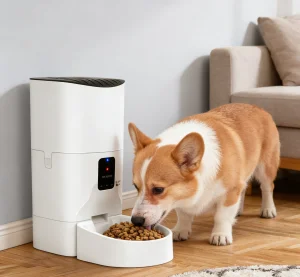
Understanding the New Role of Connected Pet Devices
Traditional pet-care tools generally depend on owners being physically present. A connected device can instead collect information, respond to predefined conditions, or communicate activity data to another device. That distinction creates opportunities for monitoring feeding habits, movement, environmental conditions, and other aspects of an animal’s routine.
The value of a wearable or connected product depends heavily on what information it captures and how that information is interpreted. Sensors need suitable placement, while the electronics must fit within a form factor that does not interfere with normal animal movement. Battery consumption also becomes an important consideration because frequent charging can make a technically capable product inconvenient in everyday use.
Pet hardware also has to account for conditions that differ from conventional consumer electronics. Movement can be unpredictable, surfaces may encounter moisture or dirt, and components need to coexist with materials designed around comfort and safety. These practical factors should influence the product definition before engineers settle on the final architecture.
Turning Pet-Care Ideas Into Practical Hardware
A useful concept begins with a clearly defined scenario rather than a list of fashionable features. Developers might ask whether the device is intended for activity monitoring, location-related functions, feeding assistance, or another specific task. Such questions help narrow the required sensors, communication methods, power strategy, and physical design.
Within electronics manufacturing services, requirement analysis and feasibility assessment can connect those early decisions with realistic component and cost considerations. Minewing’s published development process includes requirement analysis, target-user scenarios, component selection, cost targets, and technology-stack assessment before engineering begins.
A useful example from our project portfolio is the Smart Automatic Pet Feeder. The device combines intelligent sensors, wireless connectivity, programmable control, food-level monitoring, feeding-history tracking, and mobile control, while its dispensing mechanism is designed around precise portions and quiet operation. The project illustrates how pet-focused hardware can combine mechanical, electronic, and software considerations within one product.
Why Miniaturization Matters in Pet Wearables
Size becomes a particularly important design variable when electronics are placed on or near an animal. A larger enclosure may provide more internal space, but it can also affect comfort and movement. Engineers therefore need to consider PCB dimensions, component placement, battery capacity, antenna positioning, and mechanical structure as an interconnected system.
An electronics manufacturing services provider can be valuable during this stage because hardware design and manufacturing considerations can be examined together. PCB development, signal integrity, miniaturization, and mechanical design all influence whether a compact connected device can move naturally from an early concept toward a manufacturable design.
Prototype testing provides another layer of practical feedback. A physical sample can reveal whether the enclosure is too bulky, whether component placement creates mechanical conflicts, or whether a sensor sits in an unsuitable position. Minewing supports rapid prototypes through methods including 3D printing, CNC machining, and silicone molding, allowing physical concepts to be assessed before larger production commitments.
Connecting Data With Everyday Pet-Care Decisions
Connectivity only becomes meaningful when the resulting information serves a useful purpose. A sensor that records activity, for example, may become more valuable when its data can be transmitted to a mobile application or another connected system. The communication architecture should therefore reflect the product’s intended range, power budget, data requirements, and surrounding environment.
Modern electronics manufacturing services may involve more than assembling boards and components. Minewing’s stated capabilities include wireless integration across cellular, Wi-Fi, and Bluetooth/BLE, alongside embedded architecture and low-power battery management. These capabilities are relevant to pet-care devices that need to exchange information without making frequent charging an unnecessary part of the user experience.
Data collection should also be approached with restraint. More sensors do not automatically produce a better product. A focused system that captures information relevant to a defined pet-care scenario can be easier to operate, easier to manufacture, and potentially more efficient in terms of energy use and processing requirements.
Designing a Product That Can Grow With Its Market
Pet technology can evolve quickly as owners become more familiar with connected services. A first-generation device might focus on one routine, while later versions could incorporate additional sensing, improved connectivity, or different interaction methods. Building a flexible technical foundation can make those future changes more manageable.
The transition from prototype to production requires its own assessment. Manufacturing teams may examine component sourcing, assembly methods, enclosure construction, testing procedures, and production yield before volume manufacturing begins. Minewing’s process includes EVT, DVT, and PVT trial-production stages as well as DFM optimization and supply-chain setup.
That progression matters because pet-care products are ultimately physical products used repeatedly in uncontrolled environments. The engineering decisions made during conceptualization affect not only technical performance but also manufacturability, maintenance, usability, and commercial viability.
From Connected Concepts to Useful Pet-Care Experiences
Smart pet care is not defined by connectivity alone. Its real potential comes from translating everyday animal-care challenges into hardware that collects useful information, responds appropriately, and remains practical for both pets and their owners.
We at Minewing work with startups and growing brands across concept development, engineering, prototyping, trial production, and mass manufacturing, supporting connected hardware as it progresses from an idea toward a commercial product. As pet technology becomes more sophisticated, thoughtful product definition and disciplined engineering will matter just as much as the sensors or wireless technologies inside the device.



