Supply chain resilience has become a strategic consideration for businesses developing electronic products. Semiconductor production, component sourcing, and global manufacturing networks involve multiple interconnected stages, which means a disruption at one point can affect the entire product lifecycle. The OECD highlights the complexity and geographic concentration of semiconductor value chains, while National Institute of Standards and Technology (NIST) recommends evaluating supplier resilience, provenance, and supply-chain tiers. For us, choosing between OEM and ODM should therefore begin with a practical question: which partnership model gives a business better control over its supply-chain risks?

Why OEM and ODM Matter for Supply Chain Resilience
OEM and ODM create different relationships between a product company and its manufacturing partner. Under an OEM model, the customer typically arrives with a completed design and requires the manufacturer to execute production accurately. Under an ODM model, the manufacturing partner becomes involved earlier, helping develop the product before it reaches mass production.
This distinction affects resilience because supply-chain decisions often begin before manufacturing starts. Component selection, manufacturability, production processes, testing requirements, and alternative sourcing options can all influence how easily a product can respond to disruption.
A resilient strategy therefore should not focus only on finding the lowest production price. Businesses should also consider technical capability, supplier visibility, communication, quality systems, and the ability to move efficiently from engineering to production.
When OEM Is the Stronger Choice
OEM can be an effective option when we already have a validated product design and want to maintain substantial control over the technical specifications. A typical project may provide Gerber files, BOMs, mechanical 3D drawings, testing requirements, and other production documentation.
This model allows us to focus on selecting a manufacturing partner capable of executing the design consistently. For supply-chain resilience, we should examine how that partner manages components, production planning, quality inspection, and potential material changes.
A strong OEM partner can also help reduce manufacturing uncertainty without changing the underlying product design. At Minewing, we support OEM production alongside JDM and ODM projects, with services covering prototyping, trial production, mass production, and electronics manufacturing.
When Electronic ODM Can Improve Flexibility
Electronic ODM becomes more relevant when we have a product concept or market opportunity but do not yet have a complete technical design. Instead of separating engineering and manufacturing into unrelated activities, we can work with an ODM partner that participates in the development process.
This can strengthen resilience at an earlier stage. We enable engineers to consider component availability, manufacturing processes, product architecture, and production requirements while the design is still being developed. That helps clients spot potential supply constraints before they become expensive production problems.
At Minewing, our engineers cover electronics hardware, software, structural processes, exterior design, and packaging design. We can provide technical advice during the early stage and support projects through design, prototyping, trial production, and mass production.
Component Sourcing Should Be Part of the Decision
A manufacturing partnership cannot eliminate global supply-chain risks, but it can improve how those risks are managed. The OECD notes that semiconductor value chains contain significant dependencies and bottlenecks, making diversification and better supply-chain information important resilience measures.
For OEM projects, we should therefore ask whether the manufacturer has an established component procurement process and how it handles approved alternatives. For ODM projects, we should raise these questions even earlier because component choices can influence the design itself.
At Minewing, our PCB manufacturing service sources BOM components through authorized first‑agent channels. This approach is designed to support component quality and reliable supply management.
Production Visibility Supports Resilience
Supply-chain resilience also depends on visibility after the design and sourcing stages. Businesses need to understand what happens between material procurement, assembly, testing, and shipment. Without sufficient visibility, a seemingly small production issue can become difficult to identify and resolve.
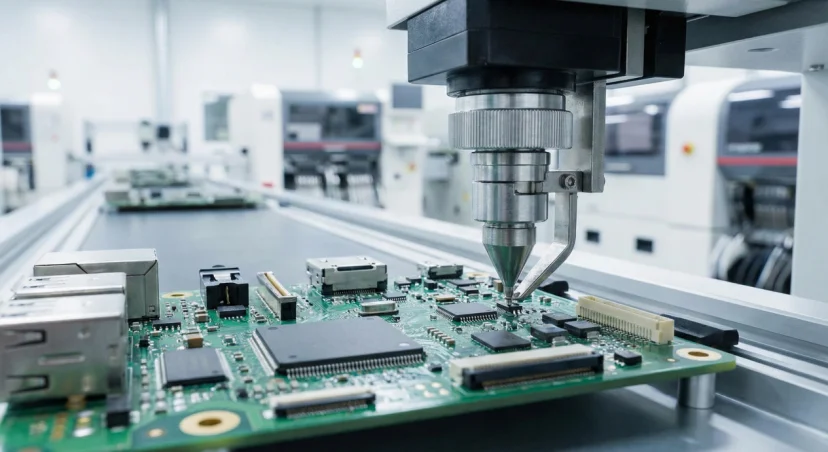
We consider integrated project management particularly valuable when product development involves several technical stages. At Minewing, our manufacturing process covers raw-material procurement, SMT, mold production, shell production, assembly, testing, packaging, and shipment.
This integrated structure can reduce the number of handoffs between separate suppliers. It does not remove every risk, but fewer disconnected interfaces can make communication and corrective action more manageable.
OEM or ODM: What Should Businesses Evaluate?
There is no universal answer to whether OEM and ODM provides better resilience. The appropriate choice depends on where the business is starting and how much technical responsibility it wants to retain.
If we already have a finalized design, OEM may provide the clearer structure. We can concentrate on manufacturing execution, quality, component sourcing, production capacity, and intellectual property protection.
If we have an opportunity but require engineering support, electronic ODM may provide greater flexibility. By involving the manufacturing partner during development, we can address manufacturability and supply considerations before the product enters volume production.
Regardless of the model, supplier due diligence should remain essential. NIST’s current supply-chain guidance specifically identifies resilience, provenance, supply-chain tiers, and foundational practices as areas worth assessing when evaluating technology suppliers.
Building a More Resilient Manufacturing Partnership
For us, supply-chain resilience is ultimately about preparing for uncertainty rather than trying to predict every disruption. A capable partner should be able to communicate clearly, manage suppliers, maintain quality, and respond when material or production conditions change.
At Minewing, we have developed an integrated electronics manufacturing system covering ideas, design, prototypes, trial production, and mass production. We also leverage our experience in supply-chain and project management to boost overall manufacturing efficiency.
By matching the partnership model to our actual needs, we can make OEM or ODM more than a purchasing decision. We can use it as part of a broader strategy for controlling technical risk, improving production visibility, and building a supply chain capable of supporting long-term product growth.
Choosing the Model That Fits Our Risk Profile
OEM and ODM represent different starting points, but both can support a resilient electronics strategy when the partnership is structured carefully. OEM is generally suitable when we already have complete engineering documentation and need dependable production execution. Electronic ODM is better suited when we need engineering expertise to transform an idea into a production-ready product.
At Minewing, we support both paths, allowing customers to enter the manufacturing process with either a finalized design or an early-stage product concept. By evaluating engineering capability, sourcing practices, manufacturing visibility, quality management, and communication alongside price, we can select a partner based on long-term resilience rather than short-term production cost alone.